
Legislate in haste, repent at leisure
They say hard cases make for bad law. Hard cases are emotionally wrenching. Read more
A comprehensive and year-long econometric analysis of data for 400,000 students undertaken by The New Zealand Initiative reveals there are no significant differences in school performance between schools of different deciles. Adjusted for the different student populations they serve, the vast majority of New Zealand’s secondary schools create the education outcomes we would expect from them. Read more
Wellington (5 April 2019): A comprehensive and year-long econometric analysis of data for 400,000 students undertaken by The New Zealand Initiative reveals there are no significant differences in school performance between schools of different deciles. Adjusted for the different student populations they serve, the vast majority of New Zealand’s secondary schools create the education outcomes we would expect from them. Read more
Dr Oliver Hartwich discusses how our comprehensive, year-long econometric analysis buries the old myth that school quality is linked to school decile. Our findings are published in our latest Research Note, Tomorrow's Schools: Data and Evidence. Read more
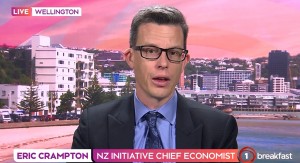
Dr Eric Crampton discusses how our comprehensive, year-long econometric analysis buries the old myth that school quality is linked to school decile. Our findings are published in our latest Research Note, Tomorrow's Schools: Data and Evidence, written by Joel Hernandez. Read more
Our latest research, Tomorrow's Schools: Data and Evidence, carried out over a year, looked at data of 400,000 students and revealed there are no significant differences in school performance between schools of different deciles. Dr Oliver Hartwich, the Initiative's Executive Director discussed our research on Radio New Zealand. Read more
Dr Oliver Hartwich speaks to Guyon Espiner about our latest research, Tomorrow's Schools: Data and Evidence. This report comes at the end of a comprehensive, year-long data analysis of 400,000 students and shows that once family background is separated out, most schools have about the same impact on their students' learning - no matter their decile. Read more
Our Chief Economist Dr Eric Crampton talks to Newstalk ZB's Kate Hawkesby about findings from our latest research, Tomorrow's Schools: Data and Evidence, and the importance of comprehensive, evidence-based research when it comes to looking at school performance. The Initiative has developed a school performance tool with the primary purpose of evaluating the relative effectiveness of every secondary school in New Zealand. Read more
Following the release of our Research Note, Tomorrow's School: Data and Evidence, our Chief Economist Dr Eric Crampton chats to Newstalk ZB's Heather du Plessis-Allan about our comprehensive and year-long econometric analysis of data for 400,000 students that reveals there are no significant differences in school performance between schools of different deciles, and how this data could be used by the Ministry of Education to help improve education outcomes for New Zealand students.
Listen to the full interview below:
Read more
Complaining about a housing crisis in New Zealand has become a national sport, spawning all sorts of wrong policy remedies. New Zealand’s housing issue is a supply problem: The country’s rules and institutions are not conducive to a thriving building industry. Read more
The question of how to help schools face challenging circumstances was a key focus of Monday’s Tomorrow’s Schools review discussion held jointly by the Initiative and Victoria University’s Faculty of Education. The Tomorrow’s Schools Taskforce is clear, and the Initiative agrees, that there is a serious and stubborn problem of underachievement among students from certain ethnic and socioeconomic backgrounds. Read more
Oscar Wilde once quipped that a cynic was “a man who knows the price of everything and the value of nothing”. That saying has since migrated to refer to economists. Read more
For those of us of a certain age, part of the thrill of staying up late as a kid was getting to see and hear things on television that did not air during afternoon cartoons. Before 9pm, one set of rules applied. Read more
Of all the people in the world, former British Prime Minister David Cameron is probably the last person anyone wants to listen to on Brexit. After all, it was Cameron’s idea to hold the 2016 referendum that started the downfall. Read more
If the electricity sector were art, New Zealand would be “the Mona Lisa.” And countries like Australia, the UK and Germany would rank somewhere behind graffiti. New Zealand has an outstanding electricity system. Read more