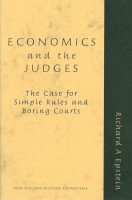
Economics and the Judges: The Case for Simple Rules and Boring Courts
This paper investigates the use of economic theory by common law judges. I shall begin that inquiry by propounding a gentle paradox. Read more
1 June, 1996


You searched everything for "" and got 2865 results
This paper investigates the use of economic theory by common law judges. I shall begin that inquiry by propounding a gentle paradox. Read more

The purpose of this study, which was supported by the New Zealand Business Roundtable, is to suggest the guiding principles for the reform of the welfare state. Plainly any such task involves taking a view about the ideal of a free society. Read more
Fiscal matters will be among the most important issues to be addressed by the government over the next few years. An improving fiscal outlook will provide considerable scope to reduce taxes once net debt is reduced to a prudent level. Read more
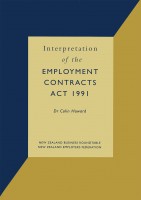
Preliminary observations: The brief I accepted in preparing this report was to comment on employment law developments in New Zealand since the Employment Contracts Act 1991 (‘the ECA’) commenced operation on 15 May 1991. The ECA has major political, social, and economic, as well as legal, significance. Read more

There are many aspects of the global picture I might cover with you today. But I would prefer to deal with one particular aspect at length so I propose to talk mainly about why the concept of the United Europe has become a threat to New Zealand, and what we can do about it. Read more
This submission on the Local Government Law Reform Bill (“the Bill”) is made jointly by the Auckland Regional Chamber of Commerce & Industry, the Building Owners and Managers Association of New Zealand (BOMA), Federated Farmers of New Zealand, the New Zealand Business Roundtable (NZBR), the New Zealand Manufacturers Federation and the Wellington Chamber of Commerce. It is in response to the September 1995 submission made by the New Zealand Local Government Association (“the LGA’s submission”). Read more

This submission considers to what extend, and at what cost, the bill may further objectives of the education system. We note that until 1991, the registration regime for teachers was compulsory. Read more

This submission by the NZBR responds to the Attorney-General's invitation for comment on the report of the Solicitor-General, Appeals to the Privy Council (released on 5 May 1995), which is referred to as the "Report". The Report is understood to have been sought by the government to assist it in making an 'in principle' decision on whether or not to retain the availability of appeals to the Privy Council. Read more

The activities of the Council and its requirements for revenue to fund them affect the well-being of Aucklanders and the region generally. They can detract from economic and social well-being if they divert resources from more productive to less productive uses. Read more

The essential conclusions of our analysis are that to maximise the contribution of the kiwifruit industry to the economy and to establish a dynamic environment for kiwifruit exporting, substantial reforms to industry structures are required. Read more