Nobody is planning to invade us
If nobody is planning to invade New Zealand, why would we need a defence force? So runs the logic of those questioning the decision to increase defence spending. Read more
General John Howard is a retired military leader who now works with boards and senior executives as a private advisor on strategy, risk and organisational
performance. John's consulting work focuses on helping executive teams interpret complex strategic operating environments, align strategy and risk, and make clear decisions when the stakes are high and the information is imperfect. He brings a calm, inquiring strategic lens to decision making at the highest level, drawing on over four decades of service in some of the most complex defence, intelligence and national security environments.
John has held a number of senior military leadership roles including Commanding Officer of the 1st Battalion, Royal New Zealand Infantry Regiment; Commander of the Deployable Joint Interagency Task Force; before being appointed the inaugural Chief of Defence Intelligence for the New Zealand Defence Force (NZDF). In that role he was responsible for shaping NZDF's strategic intelligence enterprise, integrating complex information environments and supporting government decision makers under conditions of uncertainty. This role saw John serving as a principal across a full range of Five Eyes intelligence boards as well as at the highest level in Military Intelligence NATO.
Internationally, John has held significant appointments within the United States defence and intelligence system, including serving as the responsible Officer in the role of Deputy Director for Commonwealth Integration at the U.S. Defense Intelligence Agency, Washington (the world's largest All Source Intelligence Agency). In this role he was the only non-US executive officer serving across all 18 agencies and departments of the US Intelligence Community. He has also served as a senior national officer at U.S. Central Command, Tampa. These positions placed him inside the core of the U.S. and Five Eyes Intelligence Community and saw him working daily with senior civilian and military leaders on some of the most demanding global security problems.
Alongside his operational and intelligence experience, John has led sensitive work with international governmental organisations at the highest levels, building an extensive global network across defence, security, diplomatic and multilateral institutions, including NATO. He holds a Master of Management & International Defence Studies, and a Master of Strategic Studies. John is a graduate of the Company Directors Course from the Institute of Directors for New Zealand. John was appointed as a Member of the New Zealand Order of Merit for his strategic leadership in East Timor. He was presented with the US legion of Merit (Officer Grade) from the US Secretary of Defence, and has twice been awarded the US Meritorious Service Medal.
If nobody is planning to invade New Zealand, why would we need a defence force? So runs the logic of those questioning the decision to increase defence spending. Read more
In this episode, Oliver talks with John Howard, senior fellow at the New Zealand Initiative, about why he sees no negotiated settlement over Iran in the next 30 to 60 days, and what prolonged disruption in the Strait of Hormuz exposes about New Zealand's fuel and fertiliser supply. They also ask whether the increase in defence spending from 1.1 to 2 per cent of GDP is being converted into actual hardware and personnel, and assess Defence Minister Chris Penk's opening months in the job, including his $300 million announcement on attack drones. Read more
Major General John Howard talked to Ryan Bridge on Newstalk ZB about the Defence Minister's announcement that New Zealand will get long range, one-way strike drones, with the Minister wanting a New Zealand company to make them. Howard pointed to the size of New Zealand's exclusive economic zone and to cost in explaining why the drones are one way, and called it a great decision to invest in lower cost capabilities that deliver strategic effect and deterrence. Read more
When Oliver Hartwich suggested my next research note, I thought he was joking. It was a single question: What is a frigate? Read more
On July 5, the Prime Minister announced plans for free trade agreements with seven more countries, on top of the deal with India he signed in April. The next day, a Chinese submarine fired a missile from the South China Sea into the Pacific. Read more
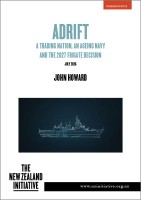
In this webinar, we launch our new research note "Adrift: A Trading Nation, an Ageing Navy and the 2027 Frigate Decision". Author Major General (Retired) John Howard presents key findings on why a trading nation like New Zealand needs a frigate and what is at stake in the 2027 replacement decision, joined by commentary from Major (Retired) Tim Ewing-Jarvie. Read more
Wellington (Tuesday, 14 July 2026) – New Zealand's two main warships will reach the end of their working lives within about a decade, and Cabinet must decide by 2027 what should replace them. The choice will shape the country's ability to help keep its trade routes open for a generation. Read more
New Zealand's two main warships will reach the end of their working lives within about a decade, and Cabinet must decide by 2027 what should replace them. The choice will shape the country's ability to help keep its trade routes open for a generation. Read more
In this episode, Oliver talks with retired Major General John Howard about a crowded few weeks in global security, from the NATO summit in Türkiye and Trump's renewed comments about Greenland to Russian pressure on Poland's border. They focus on what China's submarine-launched ballistic missile demonstration on 6 July and Australia's new security agreement with Fiji mean for New Zealand, and why our national security system is not moving at the speed of relevance. Read more
In this episode, Oliver talks with retired Major General John Howard about his recent trip to Washington and what the conflict centred on Iran and the Strait of Hormuz reveals about American power and the international order. They then turn to New Zealand, where Howard argues the crisis exposed serious gaps in fuel resilience and intelligence, and a public service that struggled to match ministers' urgency. Read more
In this episode, Oliver talks with senior fellow John Howard about mounting geopolitical instability, from Iran and the Strait of Hormuz to Trump's visit to Beijing and the growing pressure on Taiwan. They discuss what these crises mean for New Zealand's energy security, political leadership, European security, business risk, and the need for more serious strategic thinking. Read more
The guns have paused in the US-Iran conflict but Oliver Hartwich and John Howard argue New Zealand should take little comfort from that. All parties are struggling to find an off-ramp, damage to Qatar's refineries alone means a two-to-three-year rebuild, and New Zealand still lacks the energy strategy promised in 2024. Read more
The Government's 2025 Defence Capability Plan allocates $12 billion over the next four years—the biggest outlay in generations and long overdue. The challenge is that the defence acquisition machinery was built for a slower, steadier world and has not been rebuilt for this one. Read more
New Zealand's defence investment is landing the same way it always has: slowly, bureaucratically, and after the need has already been declared. In this webinar, retired Major General John Howard presents his new report God Defend New Zealand, which argues the country must move from an industrial-age acquisition model to one that operates at the speed of technological change. Read more
Wellington (Thursday, 23 April 2026) - The Government’s 2025 Defence Capability Plan commits $12 billion over four years, including $9 billion of new spending. But without institutional reform, new money risks being absorbed into a system too slow and fragmented to deliver modern capability, a new report from The New Zealand Initiative warns. Read more