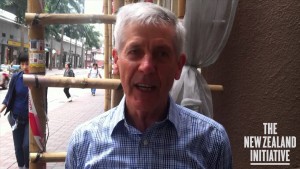

Dr Bryce Wilkinson discusses KPMG's Foreign Direct Investment analysis
Dr Bryce Wilkinson of The New Zealand Initiative discusses KPMG's Foreign Direct Investment analysis on TVNZ Breakfast, 17 August 2015. Read more
Bryce is a Senior Fellow at The New Zealand Initiative and the Director of the Wellington-based economic consultancy firm Capital Economics.
Prior to setting up his consultancy in 1997, he was director, and shareholder in First NZ Capital. Before moving into investment banking in 1985, he worked in the New Zealand Treasury, reaching the position of Director.
Bryce holds a PhD in Economics from the University of Canterbury and was a Harkness Fellow at Harvard University. He is a Fellow of the Law and Economics Association of New Zealand.
Phone: +64 4 499 0790
Dr Bryce Wilkinson of The New Zealand Initiative discusses KPMG's Foreign Direct Investment analysis on TVNZ Breakfast, 17 August 2015. Read more
Central government is squandering billions of dollars of householders’ income. It is doing so simply because it lacks the incentive to assess value for money with sufficient rigour. Read more
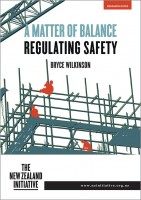
This week we released a research report, A Matter of Balance: Regulating Safety. It looked into the costs and benefits of Ministry for Business, Innovation and Employment's (MBIE) campaign to reduce workplace injuries from falls from heights of less than 3 metres in residential construction. Read more
The construction industry has made some substantial and laudable moves towards better safety practices. But recent changes in WorkSafe regulations, mandating extensive and expensive scaffolding for roof repairs and new builds adds, indicatively, from two to seven thousand dollars per project. Read more
The Kapiti News reported on 17 June 2015 that lower water consumption following the advent of water metering "now means a pricing increase to recover the costs" of piped water supply. Considerable local scoffing ensued. Read more
Auckland City, Auckland house prices. Politically, that is the government's most immediate local government issue. Read more
This week, The New Zealand Initiative released a report assessing social impact bonds in a New Zealand context. The report identifies both opportunities and challenges. Read more
This report explains the concept of Social Impact Bonds (SIBs), its application worldwide, and its potential in New Zealand. SIBs are a new and innovative means of financing and delivering social services through the private sector, where the government usually only pays for what works. Read more
Your property rights count for very little under the Resource Management Act 1991 (RMA), yet they count for a great deal under New Zealand’s Public Works Acts (PWA) that date back to the 19th century. If the government dictates the future use of your land under the PWA ,you are entitled to compensation but not if it does so under the RMA. Read more
Senior Fellow Dr Bryce Wilkinson discusses The New Zealand Initiative's work on foreign direct investment in New Zealand. Read more
Bloomberg has just published its list of the 15 most miserable economies in the world for 2015. Misery is measured as the sum of the unemployment rate and the inflation rate. Read more
The Parliamentary Commissioner for the Environment (PCE) has hired Crown research institute NIWA to draw up coastal hazard lines. Yet the 2012 hazard line guidance co-authored by NIWA staff fails to define, even in principle, what likelihood such lines are meant to represent, let alone justify that choice in cost-benefit terms. The folly of coastal hazard lines of unknown likelihood and net benefit is illustrated by the experience in 2012-14 of the Kapiti Coast District Council. Read more
Could the Green Party of Aotearoa become an environmental party that was neutral, if not liberal on economic issues? Must it see economic growth and a healthier environment as opposites rather than complements? Read more
Lower prices from productivity gains and lower import prices relative to export prices are a good thing. Yet many overseas commentators worry about price deflation. Read more
One critical response to my 12 January 2015 Dominion Post article here on the need for the benefits from government scaffolding regulation to exceed the costs asserted that: This misses the point that that decisions about people's safety at work should never be based solely on money. There is a moral test that also needs to be satisfied. Read more