
Why central banks commonly ease up on inflation too soon
Consumer price inflation in New Zealand is not beaten. The Reserve Bank might decide it has cut interest rates a bit too much. Read more
Bryce is a Senior Fellow at The New Zealand Initiative and the Director of the Wellington-based economic consultancy firm Capital Economics.
Prior to setting up his consultancy in 1997, he was director, and shareholder in First NZ Capital. Before moving into investment banking in 1985, he worked in the New Zealand Treasury, reaching the position of Director.
Bryce holds a PhD in Economics from the University of Canterbury and was a Harkness Fellow at Harvard University. He is a Fellow of the Law and Economics Association of New Zealand.
Phone: +64 4 499 0790
Consumer price inflation in New Zealand is not beaten. The Reserve Bank might decide it has cut interest rates a bit too much. Read more
In this episode, Oliver, Nick and Bryce talk about the Fast Track Approvals Amendment Bill, focusing on the use of Henry VIII clauses that allow ministers to amend legislation without full parliamentary scrutiny. The discussion examines why these powers have typically been used only in genuine emergencies, how their application in planning reform raises constitutional questions, and why the Initiative recommends clearer limits and stronger sunset provisions to protect democratic processes. Read more
Wellington (Thursday, 13 November 2025) – The New Zealand Initiative welcomes Parliament’s enactment today of the Regulatory Standards Bill. The Bill requires the government of the day to be much more transparent to Parliament than before about why it is asking Parliament to pass laws and regulations. Read more
1. SUMMARY 1.1 The Initiative welcomes and supports this inquiry. Read more
ou do not have to own someone's house to help them, so why does Kāinga Ora's Reset Plan envisage continuing to own around 78,000 housing units? This week, The New Zealand Initiative published my report "Owning less to achieve more: Refocusing Kāinga Ora". Read more
In this episode, Oliver talks to Bryce Wilkinson about his new report examining Kāinga Ora, New Zealand's largest social housing provider, which manages around 78,000 units housing 200,000 people at a cost of roughly $2 billion annually to taxpayers. Bryce argues that the government could better support vulnerable New Zealanders by transitioning away from direct housing provision towards voucher schemes and other market-based alternatives that give tenants more choice whilst reducing costs. Read more
Why does the government need to continue owning or managing more than 77,000 housing units, given its poor track record in this area, especially when state assistance can be provided without extensive government ownership? And why does it not release more land for housing? Read more
Wellington (Thursday, 16 October 2025) - Why does the government need to continue owning or managing more than 77,000 housing units, given its poor track record in this area, especially when state assistance can be provided without extensive government ownership? And why does it not release more land for housing? Read more
You do not have to own someone's house to help them, so why does Kāinga Ora's Reset Plan envisage that it will continue to own around 78,000 housing units? After all, social housing can be owned by any combination of central and local government agencies, housing associations, community housing providers, iwi providers, not-for-profit charitable organisations and for-profit landlords. Read more
Dr Bryce Wilkinson talked to Ryan Bridge on Newstalk ZB about his report finding that operating Kainga Ora's 77,000 state houses costs twice as much as the private sector. He argued for transferring state housing to community housing providers or tenants themselves, citing international examples and emphasising the need to empower tenants with more housing options. Read more
This webinar launches "Owning Less to Achieve More: Refocusing Kāinga Ora", a report by Dr Bryce Wilkinson arguing that government should fund people, not property. Hosted by Dr Oliver Hartwich and featuring the Rt Hon Sir Bill English (former Prime Minister; chair of the 2024 Independent Review of Kāinga Ora), the discussion explores how separating funding from ownership through voucher-style support, releasing under-utilised land, and diversifying providers could lift housing outcomes, restore fiscal sustainability, and empower tenants—drawing on OECD practice and New Zealand’s social investment approach. Read more
Dr Bryce Wilkinson talked to Wallace Chapman on RNZ's The Panel about the our report "Owning Less to Achieve More", which proposes housing vouchers for state housing tenants as an alternative to direct government ownership. Dr Wilkinson explained how vouchers could empower tenants through provider choice, similar to the pre-school education model, while panellists Sue Bradford and Dean Hall debated the importance of housing stability versus addressing inefficiencies in the current system. Read more
This week, 20 economists published an open letter calling for increased government spending. They argue that spending now will reduce economic pain. Read more
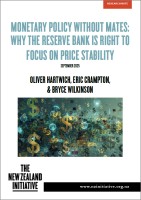
Wellington (Monday, 22 September 2026) - The Reserve Bank of New Zealand has been unfairly scapegoated for the current recession when it was simply doing its job of bringing inflation under control, according to new research from The New Zealand Initiative. The research note, Monetary Policy Without Mates, reveals that while the RBNZ fought to tame inflation that peaked at nearly 8%, the government's fiscal policy worked against these efforts – forcing interest rates to stay higher for longer. Read more
The Reserve Bank of New Zealand has been unfairly scapegoated for the current recession when it was simply doing its job of bringing inflation under control. The research note, Monetary Policy Without Mates, reveals that while the RBNZ fought to tame inflation that peaked at nearly 8%, the government's fiscal policy worked against these efforts – forcing interest rates to stay higher for longer. Read more