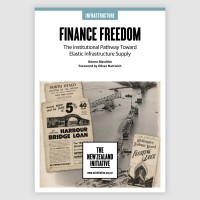
Finance Freedom
New Zealand cannot build enough houses because councils cannot afford the pipes and roads that new suburbs need. That is the conclusion of a new report by The New Zealand Initiative. Read more
You searched everything for "" and got 2980 results
New Zealand cannot build enough houses because councils cannot afford the pipes and roads that new suburbs need. That is the conclusion of a new report by The New Zealand Initiative. Read more
Wellington (Wednesday, 17 June 2026) – New Zealand cannot build enough houses because councils cannot afford the pipes and roads that new suburbs need. That is the conclusion of a new report by The New Zealand Initiative. Read more
Dr Oliver Hartwich talked to Michael Laws on The Platform about Labour's public transport policy. He argued the policy was released without a proper discussion document or modelling, and that its figures on cost, savings and passenger numbers do not stack up. Read more
Warren Pyke is, by all accounts, a serious practitioner. Thirty-five years acting for the underprivileged, the vulnerable, the mentally ill, the villainous and a great many “ordinary folk” is real civil-liberties work. Read more
Dr Oliver Hartwich talked to Wallace Chapman on RNZ's The Panel about the New Zealand Initiative's election recommendation to introduce a lower youth wage, which he argued would tackle high youth unemployment by giving 16 and 17 year olds a path into work and structured training. Dr Hartwich pointed to Central European countries such as Germany and Switzerland, where lower wages are paired with three or four year training programmes leading to a certified qualification, while panellists were divided on whether the idea risked exploiting young workers. Read more
In this episode, Eric talks with Jillaine Heather, Chief Executive of the Free Speech Union, about the Government's plans for an under-16 social media ban and the universal age verification that may come with it. They examine why the Department of Internal Affairs appears to be building delivery machinery ahead of any legislation, what Australia and the UK reveal about compliance and scope creep, and why policy aimed at online harms could create serious risks for privacy and free speech. Read more
Across the Tasman, anger has propelled Pauline Hanson’s One Nation from a fringe outfit to the most popular party, on 31 percent in a recent poll, ahead of both Labor and the Coalition. Yet Australia’s preferential voting, which redistributes losing candidates’ votes, could still return a Labor government. Read more
In May 2025, University of Otago Vice-Chancellor Grant Robertson eloquently explained why universities, as institutions, should be neutral on matters of public and political debate. If universities take stances on political issues, he said, they place members of their communities with different views in a difficult position. Read more
Once a year, as the days shorten, a great migration begins. From the warm offices of Wellington and the cafes of central Auckland, the political class sets out for Mystery Creek, where the gates of Fieldays open and the country remembers that it has a countryside. Read more
When Victoria University of Wellington’s great little prediction market, iPredict, announced that it would be shutting down back in 2015, it had a couple hundred thousand dollars of traders’ deposited funds in the bank. It was a very small, very limited, academic enterprise. Read more