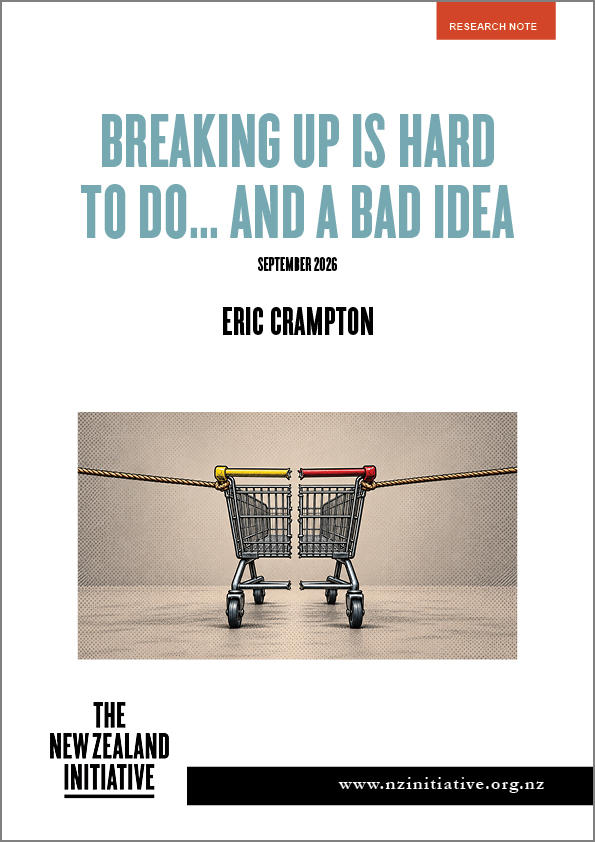


National wants to pass a law forcing Foodstuffs to split in two if the Commerce Commission signs off. PAK'nSAVEs and New Worlds would become members of separate nationwide co-operatives.
This research note says the split is not strong enough to justify threatening basic property rights.
Foodstuffs is two co-operatives, one in each island, owned by several hundred local owner-operators. Each runs PAK’nSAVE, New World and Four Square. The National Party justifies its policy by a cost-benefit study commissioned by MBIE and written by Sense Partners, which says grocery prices would fall. The Commerce Commission would get six months to test the cost-benefit assessment and $5 million to plan the split.
In Breaking up is hard to do... and a bad idea, our Chief Economist Dr Eric Crampton finds three problems.
First, even if the numbers are correct, they are inadequate to justify a break-up. The study estimates a gain equivalent to just 1.1 percent of grocery industry revenue over 20 years. If the extra cost of running two supply chains is higher than assumed, that gain vanishes and becomes a loss.
Second, important assumptions should have been stress-tested before threatening breakups. The study assumes that existing stores would remain viable despite the modelled fall in profit being comparable to current profits. And benefits depend on how Foodstuffs sets prices and locations across its banners.
Finally, truly liberalising entry would be needed if National hopes that new PAK’nSAVEs will open next door to existing New Worlds. But the larger the potential gains from a break-up, the larger the potential profits to a new entrant happy to take customers from both banners.
On the basis of an indicative cost-benefit assessment, Parliament would dissolve voluntary co-operatives and force their members to duplicate what they built. Every other large business would then ask who is next; fuel, building supplies, banking and electricity have all been named in past inquiries or current discourse. The cost of capital for every firm exposed to this risk would rise.
"The study's authors laudably noted its limitations and the additional work that was still needed," Dr Crampton said. "That work should have been undertaken well before threatening breakups."
The Initiative says the real barrier is that it has been close to impossible to build a new supermarket chain here. Council plans often allow just one in a town centre and cap its size. The supermarket fast-track was only legislated in December 2025. The note recommends fixing zoning and consenting first, simplifying alcohol licensing and labelling rules for new entrants, and testing the pricing and viability assumptions before any bill is written.
"Make it legal to build supermarkets, then find out whether anyone wants to come," Dr Crampton said. "That costs the taxpayer nothing, takes nothing from anyone, and we learn something real."