New Zealand By Numbers - 2026 Edition
Is New Zealand a country in decline or a quiet success story? A new report from The New Zealand Initiative argues it is neither. Read more
New Zealand once had an education system other countries came to study. Over two decades it has slid, on international measures and against its own past performance, and a large minority of young New Zealanders now leave school without the reading and mathematics that further study, skilled work and ordinary adult life demand.
That decline was not caused by a shortage of goodwill or money. It followed from ideas, chiefly that knowledge matters less than generic competencies, that children construct their own understanding with minimal instruction and that a qualification should record whatever a student happened to do rather than what they know. Those ideas were adopted with enthusiasm and almost no evidence, and the results arrived on schedule.
The Initiative argues for a knowledge-rich curriculum taught explicitly by well-prepared teachers, qualifications that mean the same thing in every school, honest public reporting of what students actually achieve and vocational pathways built as a genuine equal to university rather than a consolation prize.
Every child is owed a school that teaches them something.
Additionally, Professor Elizabeth Rata of the University of Auckland has recorded four sessions for The New Zealand Initiative on how to design a Knowledge Rich School Curriculum using the Curriculum Design Coherence Model. To view her presentations, click here.

Featured Publication
Is New Zealand a country in decline or a quiet success story? A new report from The New Zealand Initiative argues it is neither. Read more
This is The New Zealand Initiative’s 2026 Prescription for Prosperity. Since 2017, the Initiative has prepared a briefing for the incoming government. Read more
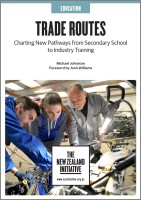
A heavy diesel mechanic earns roughly the same as a policy analyst, qualifies in the same time and graduates with little or no debt. Yet most New Zealanders still regard university as superior to industry training and our school qualifications system has quietly reinforced that bias for decades. Read more
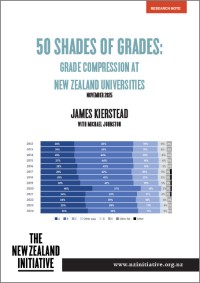
A grades are now only a few years away from becoming the most common grade awarded at New Zealand universities. The research note, ‘Fifty Shades of Grades: Grade Compression at New Zealand Universities’, builds on the Initiative's August report, ‘Amazing Grades’, which identified a substantial rise in A grades as well as rising pass rates. Read more
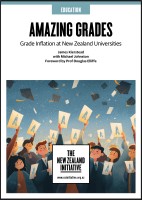
Nearly half of all grades at the University of Auckland were As during COVID-19, part of a dramatic rise in top marks that cannot be explained by academic improvement. Amazing Grades: Grade Inflation at New Zealand Universities, is the first analysis of grading patterns across all eight New Zealand universities. Read more
In this episode, Michael talks with Oliver Hartwich, Executive Director of the New Zealand Initiative, about two new reports, New Zealand by Comparison and New Zealand by Numbers, which chart how New Zealand measures up against 28 other countries and how it has changed over recent decades. They discuss why a country that attracts migrants from around the world keeps losing so many of its own people, how Australia matches New Zealand on almost everything but the economy, the Eastern European economies closing in, and wellbeing rankings that still sit near the top of the world but are slipping. Read more
Wellington (Wednesday, 22 July 2026) – Two weeks ago, New Zealand by Numbers asked whether New Zealand was improving. A new report from The New Zealand Initiative asks a harder question: is it keeping up? Read more
Victoria University of Wellington wants the teachers it trains to be ‘agents of change.’ According to the university’s handbook for teacher education programmes, teaching graduates must be committed to “social, cultural, and ecological justice.” Decoded, that means attending protests about political causes the activists lecturers find important. Providing teachers with skills to manage a classroom is not part of the brief. Read more
As a former academic, I know how onerous research publication can be. Before being published in a professional journal, an article must undergo peer review. Read more
A sense of dread has settled over schools and universities. A machine can now read in an afternoon what a scholar could not finish in a lifetime. Read more